Buying Scaffolding Boards in Nottingham: Uses, Sizes & Checks
A detailed local buyer’s guide for anyone buying scaffolding boards in Nottingham, covering best uses, common sizes, proper scaffold board checks, reclaimed vs new boards, and project advice.



If you are buying scaffolding boards in Nottingham, there is a good chance you already have a project in mind.
You might be planning garden planters, raised beds, scaffold board shelves, rustic furniture, a garage storage setup, a garden bench, a potting table, a workbench, or a full outdoor DIY build.
That is why scaffolding boards are such a popular choice. They are not just ordinary timber. Proper scaffold boards have a chunky, practical look that works well for both useful projects and feature pieces. They are wide, thick, strong-looking, and full of character, especially when you choose reclaimed boards.
For buyers across Nottingham, Nottinghamshire, Kirkby-in-Ashfield, Ashfield, Sutton-in-Ashfield, Mansfield, Hucknall, Arnold, Bulwell, Beeston, Carlton, West Bridgford and nearby areas, scaffolding boards offer a useful mix of value, strength, style and flexibility.
However, before buying, it is worth knowing what sizes are best, what projects they suit, what condition to look for, and how to tell proper scaffold boards apart from thinner scaffold-style timber.
This guide explains the best uses for scaffolding boards in Nottingham, which sizes work well for different projects, and what to check before ordering.
Quick Answer: What Should You Know Before Buying Scaffolding Boards in Nottingham?
Before buying scaffolding boards in Nottingham, think about what you are building first.
The best board for a raised bed may not be the same board you would choose for indoor shelves. The best board for a garden planter may not be the same one you would use for a smooth table top.
The main things to check are:
- Whether the boards are proper scaffold boards
- Whether they are new or reclaimed
- The board length
- The width and thickness
- The condition
- Whether they are straight enough for your project
- Whether they need sanding
- Whether they will be used indoors or outdoors
- Whether cutting to size is needed
- Whether you can collect or need local delivery
- Whether the boards suit planters, shelves, raised beds, furniture or storage
A proper scaffold board is commonly around 225mm wide and 38mm thick, which gives it the chunky look people want for shelves, planters, benches and raised beds.
The best choice depends on the project, the finish you want, and how much preparation you are willing to do.
Why Scaffolding Boards Are So Popular in Nottingham
Scaffolding boards are popular because they solve several problems at once.
They are practical enough for garden and workshop projects, but they also look good enough for shelves, furniture and rustic home features.
Many buyers want timber that feels more substantial than thin planks from a DIY shop. They want boards that can be used for proper projects, not just light decoration.
Scaffolding boards are often chosen because they offer:
- A chunky rustic look
- Useful width for shelves and raised beds
- Strong visual presence
- A practical thickness
- Multiple length options
- Good value across larger projects
- Character when reclaimed
- A natural fit for garden and DIY work
- Flexibility for cutting down into smaller pieces
This is why people search for terms like scaffolding boards Nottingham, scaffold boards near me, reclaimed scaffold boards Nottingham, used scaffold boards Nottingham, and scaffold boards for sale Nottinghamshire.
They are usually looking for timber that can do a real job.
Proper Scaffolding Boards vs Scaffold-Style Timber
One of the most important things to check is whether you are buying proper scaffold boards or just scaffold-style timber.
This matters because some boards are sold with words like “scaffold style”, “rustic scaffold shelf”, “scaffold effect”, or “scaffold board look”. These may look similar in photos, but they are not always the same as proper scaffold boards.
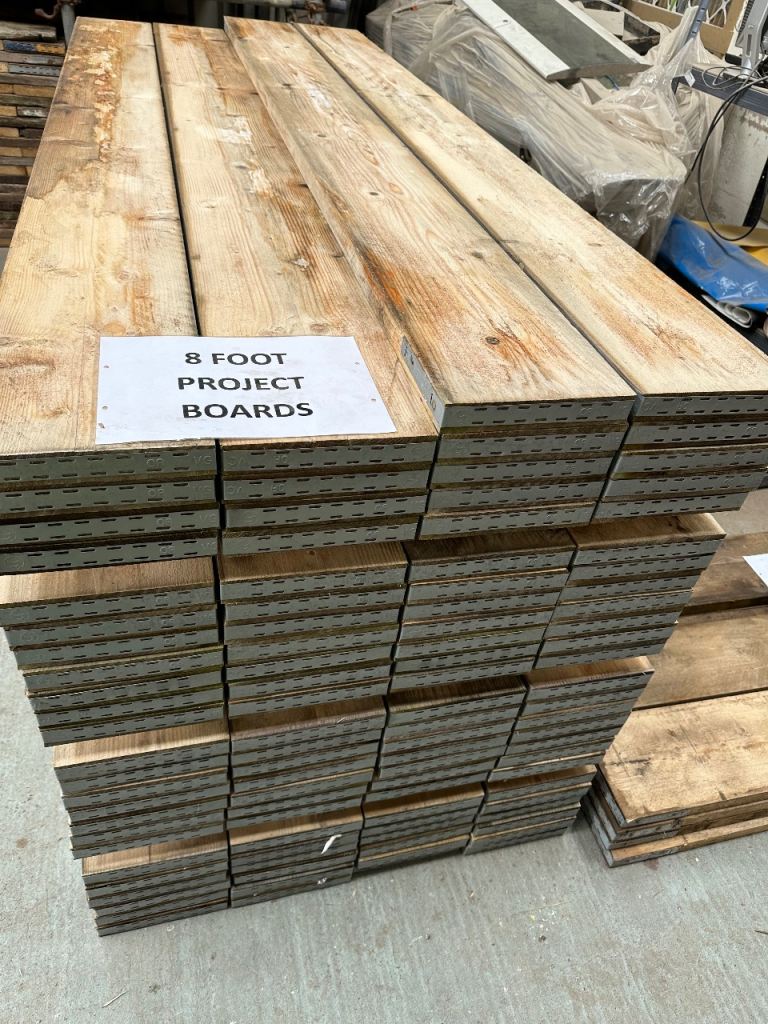
A proper scaffold board usually has:
- A chunky width
- A thicker profile
- A heavier feel
- A practical size for real projects
- A more substantial edge
- Real working-board character if reclaimed
- Metal end bands on some boards
- Marks, stamps or surface wear on some reclaimed boards
A scaffold-style board may be:
- Thinner
- Narrower
- Lighter
- Decorative rather than practical
- Made to imitate the look
- Less suitable for heavy-duty projects
- Sold mainly for light shelving or display use
There is nothing wrong with decorative timber if that is what you want. However, if you are building garden planters, raised beds, benches, tables, workbenches or garage storage, it is worth checking that you are buying proper scaffolding boards.
For many buyers, the whole reason for choosing scaffold boards is the chunky, solid, authentic look. Thin lookalike boards do not always give the same result.
What Are Scaffolding Boards Commonly Used For?
Scaffolding boards are one of the most versatile timber choices for home and garden projects.
They are commonly used for:
- Garden planters
- Raised beds
- Herb planters
- Vegetable beds
- Flower beds
- Rustic shelves
- Kitchen shelves
- Bathroom shelves
- Alcove shelves
- Garage shelving
- Workshop storage
- Garden benches
- Potting benches
- Outdoor tables
- Garden bars
- Desks
- Coffee tables
- Dining tables
- Worktops
- Mud kitchens
- Garden edging
- Shop displays
- Café shelving
- Bar shelving
- Retail displays
- DIY furniture
- Shed storage
- Log stores
- Decorative wall features
This is one of the biggest reasons people keep choosing them. One type of board can be used across many different projects.
If you are building raised beds, the offcuts may become shelves. If you are buying boards for shelves, a longer leftover piece might become a small planter. If you are building a potting bench, spare pieces might be used for storage, supports or edging.
That flexibility makes scaffolding boards useful for buyers who want timber that does more than one job.
Best Uses for Scaffolding Boards in the Garden
Garden projects are one of the strongest reasons people buy scaffolding boards in Nottingham.
The boards suit gardens because they look practical, rustic and strong. They work well with planting, gravel, brick, stone, paving, patios, sheds and outdoor furniture.
Here are some of the best garden uses.
Garden Planters
Scaffolding boards are excellent for garden planters because they create a strong, chunky look.
A planter made from proper scaffold boards often looks more permanent than a lightweight shop-bought planter. It has more presence and can be built to suit the space.
Popular scaffold board planter ideas include:
- Long trough planters
- Square feature planters
- Herb planters
- Flower planters
- Vegetable planters
- Raised planter boxes
- Patio planters
- Driveway planters
- Courtyard planters
- Border planters
- Custom-sized garden boxes
Scaffold board planters work especially well in rustic gardens, modern gardens, courtyard spaces, allotment-style areas and patios.
If the boards are reclaimed, the weathered look can blend naturally with soil, plants and outdoor materials.
For outdoor planters, it is worth thinking about drainage, lining, treatment and how the planter will sit on the ground.
Raised Beds
Raised beds are one of the most popular scaffold board projects.
They are useful for:
- Vegetables
- Herbs
- Salad crops
- Strawberries
- Flowers
- Shrubs
- Kitchen gardens
- Family growing spaces
- Allotment-style gardens
Scaffold boards suit raised beds because they create a clear, solid edge. They help organise the garden and make planting areas look more intentional.
Longer boards such as 6ft, 8ft, 10ft and 13ft are often useful because they reduce joins and create cleaner runs.
For buyers searching for scaffolding boards for raised beds in Nottingham, the main things to think about are board length, condition, treatment and whether the boards need to be cut to size.
A raised bed does not always need a perfectly smooth board. In many cases, rustic boards work well because the project is outdoors and the natural look suits the garden.
Potting Benches
A potting bench is a very practical use for scaffold boards.
It gives you a dedicated space for:
- Repotting plants
- Storing seed trays
- Preparing compost
- Keeping hand tools nearby
- Organising pots
- Creating a garden workstation
Scaffolding boards are a good choice because they feel substantial. A potting bench made from thin lightweight timber can feel temporary. A scaffold board potting bench looks more permanent and useful.
Reclaimed boards work well for this because the bench is meant to be used. Marks and texture can add to the character rather than spoiling the look.
Garden Benches
Scaffolding boards are also popular for garden benches.
They can be used for:
- Seat boards
- Bench backs
- Corner seating
- Patio benches
- Outdoor dining benches
- Garden resting spots
- Rustic seating areas
The width of the boards helps create comfortable seat sections, while the thickness gives the bench a more solid appearance.
For benches, it is worth choosing boards that are reasonably straight and suitable for sanding if the surface will be sat on regularly.
Garden Bars and Outdoor Serving Areas
Garden bars and outdoor kitchens are another popular use.
Scaffold boards can be used for:
- Bar tops
- Serving counters
- Shelves
- Back panels
- Outdoor storage
- Display shelves
- BBQ prep areas
The rustic look works well in outdoor entertaining spaces. Reclaimed boards can make a garden bar feel handmade, warm and individual.
For bar tops and counters, choose boards with a surface that can be sanded and finished properly.
Garden Edging and Borders
Scaffolding boards can also be used for edging and borders.
They can help separate:
- Lawns
- Gravel
- Flower beds
- Vegetable beds
- Bark areas
- Pathways
- Patio sections
- Planting zones
Because scaffold boards are wide and visible, they create a stronger visual edge than thin border timber.
This is useful if you want the garden to look more organised and finished.
Best Uses for Scaffolding Boards Indoors
Scaffolding boards are not just for outdoor projects. They are also very popular inside the home, especially for rustic and industrial-style interiors.
Rustic Shelves
Scaffold board shelves are one of the most popular indoor uses.
They work well in:
- Kitchens
- Bathrooms
- Living rooms
- Bedrooms
- Alcoves
- Hallways
- Utility rooms
- Home offices
- Garden rooms
The chunky edge of a proper scaffold board gives the shelf a strong feature look.
This is why many buyers search specifically for scaffold board shelves Nottingham or reclaimed scaffold board shelves. They are not just looking for any shelf. They want that rustic, solid, handmade look.
For indoor shelves, board condition matters more. You usually want boards that can be cleaned, sanded and sealed properly.
Kitchen Shelves
In kitchens, scaffold boards can be used for:
- Open shelving
- Mug shelves
- Spice shelves
- Jar storage
- Plate displays
- Plant shelves
- Cookery book storage
- Rustic wall features
They work especially well with black brackets, brick walls, neutral kitchens, farmhouse interiors and industrial-style finishes.
A reclaimed scaffold board shelf can add warmth to a kitchen that otherwise feels too plain or modern.
Bathroom Shelves
Shorter scaffold boards are useful for bathroom shelves.
They can hold:
- Towels
- Toiletries
- Baskets
- Plants
- Candles
- Decorative items
For bathrooms, finishing matters because moisture is present. Boards should usually be sanded and sealed properly for this kind of indoor use.
Alcove Shelves
Alcove shelves are another strong use.
Scaffold boards are ideal for alcoves because their thickness creates a bold look. They can turn unused wall space into practical storage.
Popular alcove shelf uses include:
- Books
- Ornaments
- Storage baskets
- Plants
- Lamps
- Records
- Home office storage
For alcoves, accurate measuring is important. This is where cut-to-size boards can be helpful.
Best Uses for Scaffolding Boards in Garages, Sheds and Workshops
Not every scaffold board project has to be decorative.
Many people buy scaffolding boards for practical storage and work areas.
They are useful for:
- Garage shelves
- Shed shelving
- Workshop storage
- Workbench tops
- Tool racks
- Boot benches
- Timber racks
- Paint storage
- Heavy-duty storage walls
- Garden equipment storage
For these projects, reclaimed boards are often ideal because they do not need to look perfect. The priority is practicality.
This is where proper scaffold boards can be much better than lightweight decorative timber. Garage and workshop storage needs boards that feel strong and useful.
Best Uses for Scaffolding Boards in Furniture
Scaffolding boards are also popular for rustic furniture.
They can be used for:
- Coffee tables
- Dining tables
- Desks
- Benches
- Console tables
- Bedside tables
- Side tables
- Worktops
- Bar tops
- Media units
For furniture, board selection matters more than it does for basic garden projects.
You usually want boards that are:
- Straighter
- Cleaner
- Suitable for sanding
- Not badly split
- Similar in thickness
- Good enough for the finish you want
Reclaimed boards can look excellent once sanded, stained, waxed or oiled, but you need to choose boards that suit the final piece.
A heavily weathered board may look perfect as a garden planter but may need more work before becoming a dining table.
Common Scaffolding Board Sizes
Scaffold boards are commonly around 225mm wide and 38mm thick, although exact measurements can vary slightly depending on the board and supplier.
The most common lengths buyers look for include:
| Board Length | Approximate Metric Length | Common Uses |
|---|---|---|
| 1ft | 0.3m | Small shelves, offcuts, signs, blocks, compact DIY projects |
| 2ft | 0.6m | Bathroom shelves, small planters, short storage shelves |
| 3ft | 0.9m | Rustic shelves, small benches, compact garden projects |
| 4ft | 1.2m | Shelves, planter sides, small raised beds, workshop storage |
| 5ft | 1.5m | Medium shelves, garden benches, planters, worktops |
| 6ft | 1.8m | Raised beds, potting benches, long shelves, garden projects |
| 8ft | 2.4m | Raised beds, benches, planters, furniture and larger DIY builds |
| 10ft | 3.0m | Long shelves, larger raised beds, tables and garden projects |
| 13ft | 3.9m | Full-length boards, large builds, cutting down into project pieces |
The right size depends on what you are making.
Shorter boards are easier to handle and useful for shelves, small planters and compact projects.
Longer boards give more flexibility because they can be cut down into several useful pieces.
Best Board Sizes for Different Projects
Here is a practical guide to choosing board sizes.
| Project | Best Board Lengths | Buying Tip |
|---|---|---|
| Small bathroom shelves | 1ft, 2ft, 3ft | Choose cleaner boards that can be sanded and sealed |
| Kitchen shelves | 3ft, 4ft, 5ft, 6ft | Check straightness and surface condition |
| Alcove shelves | 2ft, 3ft, 4ft, 5ft | Measure carefully before ordering |
| Garage shelves | 4ft, 5ft, 6ft, 8ft | Rustic boards are usually fine for practical storage |
| Garden planters | 2ft, 3ft, 4ft, 5ft, 6ft | Think about finished planter size first |
| Raised beds | 6ft, 8ft, 10ft, 13ft | Longer boards reduce joins |
| Garden benches | 4ft, 5ft, 6ft, 8ft | Choose boards suitable for sanding |
| Potting benches | 4ft, 5ft, 6ft, 8ft | Reclaimed boards work well for rustic garden workstations |
| Tables and desks | 5ft, 6ft, 8ft, 10ft | Choose straighter boards with better surfaces |
| Garden edging | 4ft, 5ft, 6ft, 8ft, 10ft | Longer boards create cleaner lines |
| Workshop benches | 5ft, 6ft, 8ft, 10ft | Prioritise strength, thickness and practicality |
| Bulk DIY projects | 8ft, 10ft, 13ft | Longer boards can be cut into multiple pieces |
If you are unsure, start with the finished size of the project and work backwards.
For example, if you want four 3ft shelves, one longer board may be enough if it can be cut down. If you are building a 10ft raised bed, buying longer boards may give a neater finish than joining several short pieces together.
What to Check Before Buying Scaffolding Boards
Before buying scaffold boards, it is worth checking the details properly.
This can save time, money and frustration.
1. Check Whether They Are Proper Scaffold Boards
Ask whether the boards are proper scaffold boards or scaffold-style boards.
This is especially important if you want the chunky, authentic scaffold board look.
Check:
- Width
- Thickness
- Weight
- Length
- Board type
- Whether they are new or reclaimed
- Whether they have real scaffold board features
If you are building planters, raised beds, benches or furniture, the difference matters.
2. Check the Board Length
Always check the length before buying.
Do not guess based on photos. A board can look longer or shorter depending on the image.
Measure your project first, then ask what lengths are available.
If you need several matching pieces, ask whether boards can be cut to size.
3. Check the Width and Thickness
Proper scaffold boards are commonly around 225mm wide and 38mm thick.
This size is one of the main reasons people choose them.
The width makes them useful for:
- Shelves
- Planter sides
- Raised bed walls
- Bench seats
- Table tops
- Worktops
- Storage shelves
The thickness gives the finished project a chunkier, stronger appearance.
If the boards are much thinner, they may not give the same result.
4. Check the Condition
Reclaimed scaffold boards vary.
Some boards may be clean and fairly straight. Others may be weathered, marked, darker, rougher or more rustic.
This is normal, but it matters depending on the project.
For garden planters and raised beds, a rustic board may be ideal.
For indoor shelves or furniture, you may want boards that can be sanded to a smoother finish.
Check for:
- Heavy splits
- Soft patches
- Rot
- Excessive warping
- Loose metal bands
- Deep damage
- Very rough surfaces
- Nails or fixings
- Strong odours
- Uneven edges
Reclaimed character is good. Serious damage is different.
5. Check Straightness
Straightness matters more for some projects than others.
For raised beds, garden edging or rustic planters, slight variation may not be a major problem.
For shelves, desks, tables and furniture, straighter boards are usually better.
If the finished project needs a clean line, ask about straightness before buying.
6. Check Surface Finish
Some boards are rougher than others.
Ask whether the boards are:
- Rough and rustic
- Lightly sanded
- Cleaner reclaimed
- Suitable for sanding
- Suitable for shelves
- Better for outdoor use
- Better for garden projects
This matters because a board that is perfect for a raised bed may be too rough for a kitchen shelf without extra preparation.
7. Check Indoor or Outdoor Suitability
Think about where the boards will be used.
Outdoor projects may need:
- Treatment
- Drainage
- Lining
- Weather protection
- Regular maintenance
- Suitable fixings
Indoor projects may need:
- Cleaning
- Sanding
- Sealing
- Waxing
- Oiling
- Staining
- Smooth edges
The same board can often be used in different ways, but the preparation may change.
8. Check Whether Cutting Is Available
Cutting can make the project much easier.
If you need specific lengths for shelves, planters or raised beds, ask whether the boards can be cut before collection or delivery.
This is useful if:
- You do not have the right saw
- You do not have space to cut long boards
- You need accurate shelf lengths
- You need boards to fit in a vehicle
- You want less waste
- You are building from a simple cut list
Cut-to-size scaffold boards can save a lot of time.
9. Check Collection or Delivery Options
Scaffold boards are bulky.
Even an 8ft board can be awkward in a normal car. A 10ft or 13ft board is even more difficult.
Before ordering, think about:
- Can you collect safely?
- Will the boards fit in your vehicle?
- Do you need them cut down?
- Do you need delivery?
- Is the delivery area suitable?
- Can boards be unloaded easily?
- How many boards are you ordering?
For many local buyers, delivery or cutting makes the difference between a simple order and a difficult one.
10. Check How Many Boards You Actually Need
It is easy to underestimate the quantity.
Before buying, write down the project properly.
For example:
- How many sides does the planter need?
- How high will the raised bed be?
- How many shelves are required?
- How many boards are needed for the bench top?
- Do you need supports or offcuts?
- Will any boards be doubled up?
- Do you need spare timber for mistakes?
- Can longer boards be cut into smaller parts?
A simple cut list can help avoid under-ordering.
New Scaffolding Boards vs Reclaimed Scaffolding Boards
Both new and reclaimed boards can be useful.
The right choice depends on the look you want.
| Board Type | Best For | Main Benefit |
|---|---|---|
| New scaffolding boards | Clean planters, matching raised beds, neat garden projects | More consistent look |
| Reclaimed scaffolding boards | Rustic shelves, garden features, furniture, character projects | More texture and personality |
| Used scaffold boards | Outdoor DIY, workshop storage, rustic builds | Practical and characterful |
| Scaffold-style timber | Light decorative shelves, display boards | Can look rustic but may not be proper scaffold board size |
New boards are often better if you want a cleaner, more uniform finish.
Reclaimed boards are often better if you want rustic charm, weathered character and a more individual look.
For many garden and DIY projects, reclaimed boards are popular because they already have the look people want.
Reclaimed Scaffolding Boards: What Makes Them Appealing?
Reclaimed scaffold boards have a look that is hard to copy.
They often include:
- Colour variation
- Grain detail
- Weathered surfaces
- Work marks
- Stamps or markings
- Metal end bands
- Aged texture
- Rustic character
These features are exactly why many people choose them for shelves, furniture, planters and garden projects.
A reclaimed scaffold board shelf looks different from a plain shelf. A reclaimed scaffold board planter looks more natural than a plastic or lightweight wooden planter. A reclaimed scaffold board bench has more presence than a thin garden seat.
The appeal is not perfection. The appeal is character.
When New Scaffolding Boards May Be Better
New boards may be a better choice if you want a cleaner and more consistent finish.
They can work well for:
- Matching raised beds
- Several identical planters
- Clean garden borders
- Neater outdoor projects
- Fresh-looking DIY builds
- Projects where you want less rustic variation
If you want every board to look more similar, new boards may be easier to work with.
However, they may not have the same aged character as reclaimed boards.
When Reclaimed Scaffolding Boards May Be Better
Reclaimed boards may be better if you want a rustic or industrial finish.
They work especially well for:
- Scaffold board shelves
- Garden planters
- Rustic benches
- Potting benches
- Outdoor bars
- Tables
- Desks
- Workshop storage
- Garden edging
- Decorative features
They suit projects where the board’s character is part of the design.
If you want something that looks handmade, natural and less mass-produced, reclaimed boards are often the better choice.
How to Choose Boards for Garden Planters
For garden planters, think about size, condition and outdoor use.
Good planter boards should be:
- Suitable for cutting
- Wide enough for the design
- Not badly rotten
- Strong-looking
- Suitable for outdoor treatment
- Practical for the planter size
Useful lengths include:
- 2ft for small planters
- 3ft for compact boxes
- 4ft for medium planters
- 5ft and 6ft for longer troughs
- 8ft and above for cutting down or larger builds
For planters, reclaimed boards often work well because rustic timber suits garden spaces.
Think about drainage and lining before filling the planter with soil.
How to Choose Boards for Raised Beds
For raised beds, longer boards are usually useful.
They create cleaner runs and reduce joins.
Good sizes include:
- 6ft for smaller beds
- 8ft for popular garden bed layouts
- 10ft for longer growing areas
- 13ft for larger beds or cutting down
For raised beds, the boards do not always need to be perfectly smooth. However, they should be suitable for outdoor use and free from major damage.
Before buying, decide:
- How long the bed will be
- How wide the bed will be
- How high you want it
- Whether you are stacking boards
- Whether you need corner posts
- Whether boards need cutting
- Whether you are lining the inside
A clear plan makes ordering easier.
How to Choose Boards for Shelves
Shelves need more attention to appearance.
For scaffold board shelves, check:
- Straightness
- Surface condition
- Edge condition
- Whether sanding is needed
- Whether the board is too rustic for indoors
- Whether the length suits the wall
- Whether brackets and fixings are suitable
Popular shelf lengths include:
- 2ft for small shelves
- 3ft for bathrooms and alcoves
- 4ft for kitchens and feature walls
- 5ft and 6ft for longer display shelves
- 8ft if cutting several shelves from one board
For indoor shelves, reclaimed boards can look excellent, but they should be prepared properly.
How to Choose Boards for Furniture
Furniture projects need the most careful board choice.
For tables, benches, desks and worktops, look for:
- Straighter boards
- Better surface condition
- Less twisting
- Suitable thickness
- Similar boards if using several together
- Boards that can be sanded and finished
- Boards with character but not severe damage
Reclaimed boards can make beautiful furniture, but not every reclaimed board is ideal for furniture.
If you are making a table top, the surface matters much more than it would for a garden bed.
How to Choose Boards for Garage and Workshop Storage
Garage and workshop projects are usually more practical.
For storage shelves and workbenches, think about:
- Length
- Thickness
- Support spacing
- Weight being stored
- Fixings
- Surface roughness
- Whether appearance matters
- Whether boards need cutting
Reclaimed boards are often ideal for storage because they are practical and do not need to look perfect.
This is a good use for boards that may be too rustic for furniture but still useful for heavy-duty DIY projects.
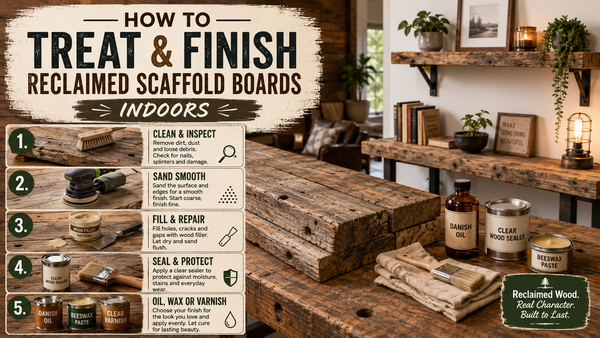
What Finish Can You Put on Scaffolding Boards?
The finish depends on where the boards will be used.
For indoor projects, common finishes include:
- Sanding
- Clear wax
- Wood oil
- Varnish
- Stain
- Paint
- Danish oil
- Hardwax oil
For outdoor projects, common options include:
- Exterior wood oil
- Outdoor wood stain
- Fence or shed treatment
- Clear exterior treatment
- Paint
- Preserver
- Lining for planters
- Drainage planning
A rustic board can look very different depending on the finish.
Light sanding can keep the character while making the board easier to handle. Dark stain can create an industrial look. Clear oil can bring out the grain. Paint can create a cleaner modern finish.
Common Finish Styles for Scaffold Board Projects
Different buyers want different looks.
Popular finish styles include:
| Finish Style | Best For |
|---|---|
| Natural reclaimed | Rustic shelves, garden features, workshop projects |
| Lightly sanded rustic | Indoor shelves, benches, tables, garden bars |
| Dark stained industrial | Shelves, desks, commercial displays, bar tops |
| Clear waxed indoor | Kitchen shelves, bathroom shelves, furniture |
| Oiled outdoor | Planters, benches, potting benches, garden tables |
| Painted black | Modern garden features, shelves, furniture |
| Weathered outdoor | Raised beds, edging, rustic garden planters |
| Smooth sanded | Furniture, desks, table tops, indoor projects |
The best finish depends on whether you want the board to look rustic, clean, modern, industrial or natural.
Are Scaffolding Boards Good Value?
Scaffolding boards can offer strong value because they are so versatile.
One board can often be used for several smaller pieces, especially if you buy a longer length.
For example:
- An 8ft board can become several short shelves
- A 10ft board can become planter sides and offcuts
- A 13ft board can be cut into multiple project pieces
- Short offcuts can become signs, supports, feet or small shelves
This makes scaffold boards useful for DIY buyers who want to get more from the timber they buy.
The value is not just in the board itself. It is in what the board can become.
Why Buying Local in Nottingham Helps
Buying scaffolding boards locally helps because the boards are large, heavy and varied.
Local buying can make it easier to:
- Check what lengths are available
- Choose between new and reclaimed boards
- Ask about condition
- Arrange cutting
- Arrange collection
- Ask about delivery
- Get advice based on your project
- Avoid ordering the wrong type of timber
- See whether the boards are proper scaffold boards
For buyers in Nottingham and Nottinghamshire, local stock can save time and make the project easier to plan.
This is especially important for larger boards such as 8ft, 10ft and 13ft lengths.
Nottingham Areas Where Buyers Search for Scaffolding Boards
People looking for scaffolding boards near Nottingham often search from across the wider area.
Common local areas include:
- Nottingham
- Nottinghamshire
- Kirkby-in-Ashfield
- Ashfield
- Sutton-in-Ashfield
- Mansfield
- Hucknall
- Arnold
- Bulwell
- Carlton
- Gedling
- Beeston
- West Bridgford
- Ilkeston
- Eastwood
- Ripley
- Alfreton
- Worksop
- Newark
A lot of buyers search for scaffold boards near me because they want boards close enough to collect or have delivered locally.
That local convenience matters, especially when buying several boards or longer lengths.
Questions to Ask Before Buying Scaffolding Boards
Before ordering, it helps to ask the right questions.
Here are some useful ones:
- Are these proper scaffold boards or scaffold-style boards?
- Are they new or reclaimed?
- What lengths do you have available?
- What is the approximate width and thickness?
- Are they around 225mm wide and 38mm thick?
- What condition are the boards in?
- Are they suitable for garden planters?
- Are they suitable for raised beds?
- Are they suitable for shelves?
- Are they suitable for furniture?
- Can they be cut to size?
- Can I choose boards?
- Are the boards straight enough for shelves or furniture?
- Do they need sanding?
- Are they suitable for outdoor use?
- Is collection available?
- Is delivery available?
- Do you have enough boards for my project?
Asking clear questions helps you avoid buying the wrong boards.
Simple Message Template for Buying Scaffolding Boards
If you are contacting a supplier, this simple message can help.
Hi, I am looking for scaffolding boards in Nottingham.
Project: Raised bed / garden planter / shelves / bench / table / garage storage / other
Board type: New / reclaimed / not sure
Lengths needed:
Quantity needed:
Finish wanted: Rustic / cleaner / sanded / not sure
Cutting needed: Yes / no / not sure
Collection or delivery:
Area or postcode:
This gives the supplier enough information to recommend the right boards.
Common Mistakes to Avoid When Buying Scaffolding Boards
Scaffold boards are useful, but it is still easy to buy the wrong thing.
Here are the most common mistakes.
Buying Scaffold-Style Boards by Accident
Some boards are advertised to look like scaffold boards but may not be proper scaffold boards.
Always check the size, thickness and description.
Not Measuring the Project First
Measure before ordering.
This is especially important for shelves, raised beds, planters, benches and tables.
Choosing Boards That Are Too Rustic for Indoor Use
A very weathered board may look great in the garden, but it may need extra work before becoming an indoor shelf.
Forgetting About Transport
Long boards are awkward to move.
Think about collection, cutting and delivery before buying.
Buying Only on Price
The cheapest boards may not be the best if they are the wrong size, too damaged, too rough or not suitable for your project.
Not Asking About Cutting
Cutting can save time and make the project easier.
If you need specific lengths, ask before ordering.
Not Planning Offcuts
Offcuts can be useful.
They can become:
- Small shelves
- Signs
- Feet
- Supports
- Brackets
- Planter parts
- Blocks
- Edging pieces
Planning offcuts helps you get more value from longer boards.
How to Build a Simple Cut List Before Buying
A cut list does not need to be complicated.
Write down:
- What you are building
- The finished length
- The finished width
- The finished height
- How many boards are needed
- How many pieces each board must be cut into
- Whether you need extra pieces for supports
- Whether you need spare timber
For example, if you are building a raised bed, write down:
- Two long sides
- Two short sides
- Corner supports
- Any extra height if stacking boards
- Any spare offcuts needed
For shelves, write down:
- Number of shelves
- Length of each shelf
- Depth required
- Bracket spacing
- Finish required
This helps you order more accurately.
Best Project Ideas for Scaffolding Boards
If you are still deciding what to make, here are some strong scaffold board project ideas.
Garden Project Ideas
- Raised vegetable beds
- Herb planters
- Flower planters
- Patio trough planters
- Potting benches
- Garden benches
- Garden bars
- BBQ prep counters
- Outdoor tables
- Garden edging
- Storage shelves
- Mud kitchens
- Log store tops
- Shed shelving
Indoor Project Ideas
- Kitchen shelves
- Bathroom shelves
- Alcove shelves
- Living room shelves
- Rustic desks
- Coffee tables
- Console tables
- Dining benches
- Bedside tables
- Utility room shelves
- Hallway storage
- Home office shelves
Workshop and Storage Ideas
- Garage shelves
- Workbench tops
- Tool storage
- Timber racks
- Paint shelves
- Boot benches
- Shed storage
- Heavy-duty wall shelving
Commercial Project Ideas
- Shop display shelves
- Café shelves
- Bar tops
- Product displays
- Salon shelving
- Market stalls
- Rustic counters
- Feature walls
This is why scaffold boards are so popular. They work across home, garden, workshop and commercial projects.
Why Scaffolding Boards Suit Garden Planters So Well
Garden planters need to look good and feel practical.
Scaffold boards are ideal because they create strong lines and a solid frame. They can turn a plain patio or garden corner into a more finished space.
They work especially well for:
- Long planters along a wall
- Matching planters around a patio
- Raised herb boxes
- Vegetable beds
- Front garden planters
- Decorative flower boxes
- Rustic courtyard planters
The boards have enough visual weight to make the planter feel intentional.
This is why scaffold boards are often preferred over thinner timber for feature planters.
Why Scaffolding Boards Suit Raised Beds So Well
Raised beds need timber that can create a clear, tidy planting area.
Scaffold boards work well because they are wide and substantial.
They help create:
- Defined growing zones
- Neater vegetable areas
- Better garden structure
- Practical planting spaces
- A rustic outdoor look
For many buyers, raised beds are not just about growing food. They are also about making the garden look more organised.
Scaffold boards help with both.
Why Scaffolding Boards Suit Shelves So Well
Shelves are one of the best uses for scaffold boards because the chunky edge becomes part of the design.
A scaffold board shelf feels different from a normal shelf.
It looks:
- Stronger
- Warmer
- More rustic
- More industrial
- More handmade
- More individual
This is especially useful in kitchens, bathrooms, alcoves and living spaces where a simple shelf can become a feature.
Why Scaffolding Boards Suit DIY Furniture So Well
Scaffolding boards are popular for furniture because they bring character.
A table, desk or bench made from reclaimed boards can look unique because each board has its own grain, marks and colour variation.
This is useful for anyone who wants furniture that does not look mass-produced.
However, furniture projects need more careful board selection. Straighter and cleaner boards are usually easier to finish well.
What Type of Buyer Are Scaffolding Boards Best For?
Scaffold boards are a good choice for:
- Gardeners building raised beds or planters
- Homeowners wanting rustic shelves
- DIY buyers building furniture
- Makers building benches or tables
- Tradespeople needing practical timber
- Workshop owners needing storage
- Small businesses wanting rustic displays
- Landlords improving storage areas
- Allotment users building growing beds
- Home renovators adding character features
They are especially useful for buyers who want timber that looks good but still feels practical.
When Scaffolding Boards Might Not Be the Right Choice
Scaffolding boards are very useful, but they are not perfect for every job.
They may not be ideal if:
- You need very thin timber
- You need perfectly smooth joinery
- You need lightweight material
- You need identical boards with no variation
- You want a very polished modern finish without preparation
- You do not want to sand or treat the timber
- You need certified structural timber for a specific engineered use
For most garden, shelf and DIY projects, they are a strong option. But it is always best to match the board to the job.
Are Used Scaffolding Boards Safe for DIY Projects?
Used scaffolding boards are commonly reused for home, garden and DIY projects.
However, once bought as reclaimed timber, they should be treated as reclaimed material for DIY use. They should not be assumed suitable for live scaffolding or working platforms unless properly inspected and approved for that specific use by a competent person.
For garden and DIY projects, check the condition carefully.
Avoid boards with:
- Rotten sections
- Severe splits
- Major structural damage
- Excessive twisting
- Soft areas
- Dangerous fixings
- Loose metalwork
- Heavy contamination
For shelves, benches and furniture, use suitable fixings, brackets and supports.
If the project needs to hold significant weight, take proper advice.
Final Thoughts
Buying scaffolding boards in Nottingham is easier when you know what to check first.
The most important thing is to start with your project. A raised bed, shelf, table, planter and garage shelf may all need different board lengths, conditions and finishes.
Proper scaffold boards are popular because they are chunky, versatile and full of character. They are not the same as thin scaffold-style timber that only copies the look.
For gardens, they are excellent for raised beds, planters, benches, potting tables, edging and outdoor storage. For homes, they are ideal for rustic shelves, alcoves, furniture and feature pieces. For garages and workshops, they are useful for practical storage, workbenches and heavy-duty shelving.
If you are searching for scaffolding boards in Nottingham, scaffold boards near me, reclaimed scaffold boards Nottingham, or used scaffold boards Nottinghamshire, focus on the basics before buying.
Check the board type, size, condition, finish, cutting options and whether the boards suit the project you are planning.
A good scaffold board is more than just timber. It is a practical starting point for a strong, useful and good-looking project.
FAQs
Where can I buy scaffolding boards in Nottingham?
You can buy scaffolding boards from local scaffold board suppliers, reclaimed scaffolding material sellers, timber yards, marketplace sellers and some timber merchants. For proper scaffold boards, a specialist local supplier is usually the best option.
What should I check before buying scaffold boards?
Check whether they are proper scaffold boards, the length, width, thickness, condition, straightness, surface quality, whether they are new or reclaimed, and whether they suit your project.
What is the difference between scaffold boards and scaffold-style timber?
Proper scaffold boards are usually chunkier, wider and heavier. Scaffold-style timber may only copy the look and may be thinner or more decorative.
What size are scaffold boards?
A common scaffold board size is around 225mm wide and 38mm thick. Lengths often include 1ft, 2ft, 3ft, 4ft, 5ft, 6ft, 8ft, 10ft and 13ft.
What are scaffolding boards good for?
They are good for garden planters, raised beds, rustic shelves, benches, tables, desks, worktops, garage storage, potting benches, garden bars and DIY furniture.
Are scaffold boards good for raised beds?
Yes. Scaffold boards are popular for raised beds because they create strong, tidy growing areas for vegetables, herbs, flowers and garden plants.
Are scaffold boards good for garden planters?
Yes. They are ideal for garden planters because they look chunky, rustic and substantial. They work well for trough planters, herb planters, flower boxes and vegetable beds.
Are scaffold boards good for shelves?
Yes. Scaffold board shelves are very popular because they have a strong rustic look. For indoor shelves, choose boards that can be cleaned, sanded and sealed properly.
Should I buy new or reclaimed scaffold boards?
Choose new boards if you want a cleaner and more consistent look. Choose reclaimed boards if you want rustic character, weathered texture and a more individual finish.
Can scaffold boards be cut to size?
Many buyers prefer cut-to-size scaffold boards because it saves time and makes projects easier. Always ask the supplier whether cutting is available.
Are reclaimed scaffold boards suitable for furniture?
Yes, but choose carefully. Furniture projects usually need straighter boards with better surfaces that can be sanded and finished well.
Can scaffold boards be used outside?
Yes, scaffold boards are often used outside for raised beds, planters, benches, garden bars and edging. For outdoor use, consider treatment, drainage and maintenance.
Do scaffold boards need sanding?
It depends on the project. Shelves and furniture usually need sanding. Garden beds, planters and workshop storage may need less preparation depending on the finish you want.
Are used scaffold boards safe?
Used scaffold boards can be suitable for DIY, garden and furniture projects if they are in good condition. They should not be assumed suitable for live scaffolding unless inspected and approved for that purpose.
Why buy scaffold boards locally in Nottingham?
Buying locally makes it easier to check stock, choose suitable boards, ask about condition, arrange cutting, collect boards or organise delivery.